Friday, December 5, 2025

Breaking News | Finance | Business | Market
Breaking News | Finance | Business | Market
As China explores creative methods to boost its economy, businesses are racing to deploy drones and low-flying vehicles for a variety of purposes. Once a sci-fi fantasy, pilotless, oval-shaped flying taxis are being tested in southern China, where they hover like tiny helicopters. Drones that deliver food are already a common sight in Shenzhen, Hong Kong's neighbor.
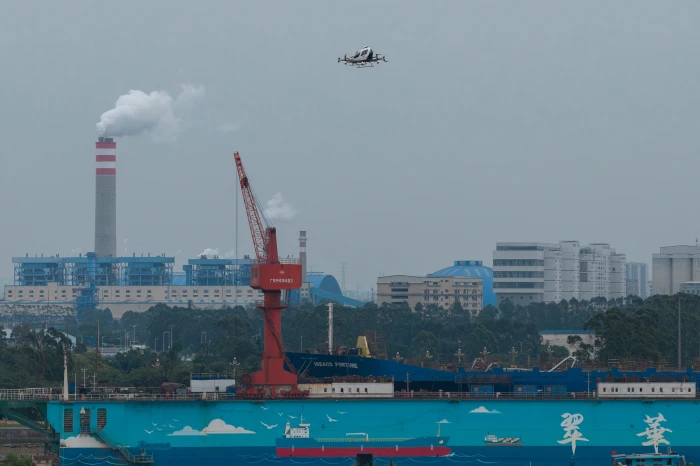
HONG KONG — As part of a test of a mini-flying taxi that was previously limited to science fiction movies, an unmanned, oval-shaped vehicle from flying taxi manufacturer EHang hovers over a riverfront innovation zone on the outskirts of the southern Chinese economic city of Guangzhou, spinning noisily like a mini-helicopter.
Even though these services are more expensive, food delivery drones are now a common sight in neighboring Shenzhen and a fresh draw for visitors. Polish tourist Karolina Trzciaň and her companions placed phone orders for bubble tea and lemon tea in the waterfront park encircled by tall buildings just to give it a try. About half an hour later, a drone zipping through the drizzle delivered their drinks.
She remarked, "It was really entertaining to watch the food being delivered by the drone because this is the first time I'm seeing something like this."
With government support, these companies are expanding rapidly, but the so-called "low-altitude economy" is facing challenges including stringent airspace regulations and battery constraints.
In 2023, corporate turnover in airspace below 1,000 meters (3,280 feet) was 506 billion yuan ($70 billion), or roughly 0.4% of China's GDP. According to Zhang Xiaolan, a researcher at the State Information Center, a think tank connected to China's primary planning agency, it is anticipated to reach 3.5 trillion yuan (about $490 billion) by 2035.
According to a report by a research unit of the Chinese Academy of Sciences, Peking University, and other institutions, Guangdong province, home to drone giant DJI with an estimated 70% of the global commercial drone market, leads in the development of the low-altitude economy, followed by wealthy eastern coastal provinces Jiangsu and Zhejiang, close to Shanghai.
EHang, Phoenix Wings, the drone division of shipping giant SF Express, and ARIDGE, the flying car division of manufacturer XPENG, are some of the other major participants in Guangdong.
Guangdong declared in October that it would promote locally issued discount coupons for low-altitude travel and expedite the building of aircraft service stations and platforms to simplify airspace operations.
Among other incentives, its financial and technological center, Shenzhen, has introduced a 15-million-yuan ($2.1 million) grant for businesses that obtain the certifications needed for passenger eVTOLs, or "electric vertical take-off and landing" vehicles that lift off the ground like helicopters.
EHang's pilotless eVTOL, a low-altitude aircraft with a maximum range of 30 kilometers (19 miles) and a top speed of 130 kph (81 mph), has been authorized by China's Civil Aviation Administration to provide commercial passenger services.
In the future, he sees citywide networks that use the rooftops of parks, schools, and shopping centers as terminals.
He stated, "It can't just be an engineer's toy or a research product."
Guo Liming, co-founder of Shenzhen-based Skyevtol, whose single-seat manned eVTOL aircraft, priced at about $100,000, can only fly for 20 to 30 minutes before it needs to be charged, stated that maintaining longer flights and overcoming battery capacity limitations are the biggest challenges for developing eVTOL aircraft.
Not all of the skies have been clear.
Following an exhibition rehearsal, two of XPENG's eVTOL aircraft collided in September, and one of them caught fire during landing. A week later, flying demonstrations at another exhibition were canceled, despite the company's claim that no one was injured.
Unfazed, XPENG has persisted in showcasing their flying vehicles, which include a detachable eVTOL plane and a six-wheeled ground vehicle. The company claimed to have over 7,000 orders worldwide for its "Land Aircraft Carrier" after investing more than $600 million, and it has started getting ready for mass production.
In July of next year, Dunhuang, a major old Silk Road destination known for its Buddhist caves and dunes, will host a trial run of tourism flights.
How soon such planes might start regularly transporting paid passengers is unknown. Some businesses in other places have used up all of their money before going to the point of commercial launch. Air taxi manufacturers Lilium and Volocopter declared bankruptcy in Germany; however, Diamond Aircraft Group, a Chinese company's affiliate, later acquired the latter.
Drone applications are not that common in China, despite years of commercialization.
Frank Zhou, general director of GBA Low Altitude Technology Co., which offers clients technological software, stated that although the nation leads in drone technology and manufacture, governmental restrictions, such as restricted airspace access, may mean abroad markets are more viable.
"If I introduce these applications to some Southeast Asian countries, their demand could explode," he remarked.
According to a paper by Zhang, a researcher at the State Information Center, less than one-third of China's low-altitude airspace was available for general aviation usage in 2023, and there were issues with unequal distribution and poor internet connectivity. She stated that, excluding private airports, the number of registered general aviation aerodromes in China was only around a tenth of those in the United States.

Deann L. Almond focuses on Entertainment trends, analyzing how business, sports, and market developments affect regional and global economies.









.webp)